Friday, 21 February 2014
FULL Draft #1 (Film Trailer)

Monday, 17 February 2014
Strangers (Film Poster)
Final Draft of my Film Poster. This is the unofficial version of it as the poster can be subject to change.

Ancillary Text 1 -Film Poster (Production)
Handmockup of Film Poster

A handrendered mockup (concept) of the desired look of my film poster.
Step 1 (The Canvas)
Having already done research for my ancillary texts I was now ready to go about producing them, starting with my film poster. I've found that the standard, international & common size for film posters (as they come in various forms) is 27 inches wide by 40 inches tall.

With the use of Photoshop I created a blank canvas with those exact dimensions with a resolution of at least 300 dpi (dots per inch) for optimum quality. Since the film poster will not be printed I left my color mode set to RGB as it will only be rendered digitally.

This stage is no doubt the most difficult part in creating any product. Using examples of film posters and my conventions analysis as a guideline it wasn't long before ideas started storming into my head.
Step 2: Image & Text (Preparation)
Conventionally, films always use photographs of scenes/shots from the actual films so I thought to follow protocol I would do the same by using shots from my film trailer. Of course, official films have much higher quality shots, for me this wasn't the case. I had to use photoshop to adjust the levels and colour correct the images of my characters to match those of existing film posters.

I went back to have a look at existing Sci-Fi film posters to see what type of fonts are used on them. In my findings I notice that designers use spaced-out normal, thin to very thin sized text formats on their posters.


I then looked at fonts that I could possibly use for my Film Poster from www.dafont.com and came across one called 'Florencesans' which seemed very suitable for the title of my film.

Step 3: Image & Text (Placement)
The poster in its primitive stages as you can see below. I've placed the edited images of my characters (extracted from live footage from my film trailer) onto the blank canvas along with the text. Conventionally, images of the main actors are placed at the very top with the title of the film near dead centre and the credits to the very bottom.
Since Sci-Fi film posters and most movie posters are generally dark in colour I painted my canvas black using the paint bucket tool and changed the text to white. From then I also entered the names of the main characters.

Since it is impossible for me to create real aliens I had to use secondary images as an option to include them on my film poster. By using a combination of different images I created my own background using layer blending and the brush tool to create a new, original image.

Secondary Images (Layer blending)

Step 4: Making the credits
This procedure was no doubt the most challenging step of the creation process because its hard to create credits from scratch. I had to keep referencing existing film posters, luckily for me, during research I came across a website where I was able to download text and a template for the credits.

I then loaded the template into photoshop alongside my film poster and used it as a guide to create my credits.

I kept the template close by on the canvas while I made mine using the type tool on photoshop.

After making my own credits, I inserted my production comany logo along with the executive producer (wyke college media) logo.

So far we can see that everything is coming together. The foundation was laid so now I was able to fine tune my product and add extra detail.

Step 5: Finalization & Fine Adjustments
I wanted to give the poster some beauty, as well as final touches so it will seem as realistic as possible. On the bottom right you'll notice a poster from 2013 Sci-Fi film 'Stranded,' I used it as my main guideline and reference point throughout the design of my poster.


Sci-Fi film posters (especially alien/space related ones) often have stars or some form of celestial object on them so I thought I would add some stars on mine. I did this by using going through different brush palettes on Photoshop and selecting one that's reflects a star.

Close up of patterns


I then thought what could I do to enhance the appearance of the title of the film and created a shadow by duplicating the layer and then blurring the bottom layer using the blur tool (creating a ghost like effect). Then I scaled up the background text layer and faded it slightly with the eraser tool to keep it subtle.

Lastly, I further enhanced the title by beveling and embossing the text to make it look three dimensional, which is what a lot of existing film posters do to make their text stand out.

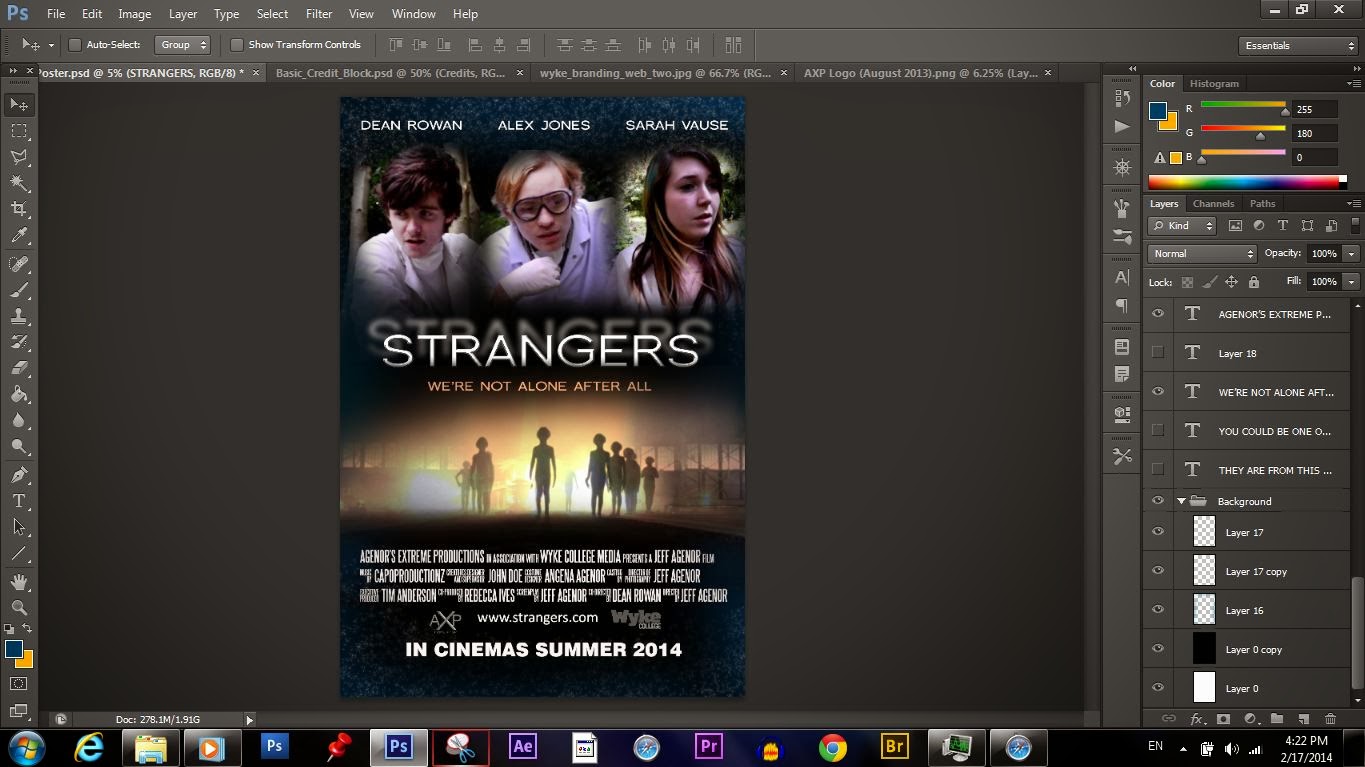
The final product loaded in photoshop with layers of all files which can be seen to the right of the screen.
Monday, 16 December 2013
Audience Feedback (Demographics)
Sample Questionnaire

I wanted to investigate what the audience think about films & film trailers. To get feedback, I generated a questionnaire which I handed out to 20 people of various age groups. I did however, split the questionnaires in half, handing out 10 in College to students and teachers and the other 10 outside of College.
Male/Female Ratio

Out of a total of 20 people, 11 Males took part in the questionnaire as well as 9 females.
Age Groups

Since it is easier to acquire a teenager's time to fill in questionnaires, especially one of this type, you'll notice that out of 20 people, 10 (A mere 50%) were between ages 13 and 18. Three of the respondents were between ages 19-25, two between ages 25-35, two were in the 36-45 age group, another two in the 46-55 category and just one in the 56-65 age group. This concludes that availability decreases with age, when it comes to researches like this. This is also due to the environment that I'm situated in most of the time as I am most of the time around people between ages 13 and 30.
Sample Question 1: Where do you see/watch film trailers most?

Out of a total of 20, 13 people suggest that YouTube & the Internet is the means by which they see film trailers the most. Or the most used source by which they see film trailers. 4 out of the 20 respondents said Movie Theatres and 3 out of 20 said Television.

Since the questionnaire was limited to only 20 samples, it makes it difficult to conclude whether or not YouTube and the Internet is the #1 means in the world by which people see film trailers. However, with the significant technological growth & advancement made over time it is safe to say that the internet has had significant impact on the way we communicate - connecting people from different parts of the world through Social Media websites & software like Facebook, Twitter, Skype etc. There are nearly 3 billion users of internet/data in the world today and with all mobile phones & tablets being produced right now having the capability to access the internet, it's fair to say that each user have seen a trailer or video at some point in owning their phones/tablets.
With with less than 50% of the respondents (Movie Theatres and Television combined) say that these are the means by which they get to see film trailers the most and a whopping 65% of the respondents say that YouTube/Online is the #1 means by which they see film trailers, it really makes me wonder ''are movie threatres and TV getting less popular?'' Yes pretty much, even though I can't fully conclude because you have to consider other parts of the world which don't have access to the internet or TV even. However, it isn't hard to say that the Internet will continue to have a significant impact on the way we communicate.
Sample Question 2: Have you ever watched a film trailer that has persuaded you to go and watch the film?

I also wanted to find out how effective film trailers really are, in terms of persuading an audience to watch a film. Out of 20 participants, 19 said that they've been persuaded to watch films more than once by film trailers. Only 1 said that they've only been persuaded once by a film trailer to go and watch a film.

It's safe to say that film trailers are very effective in terms of their purpose, which is to persuade an individual or a target audience to go and watch a film.
SQ 3: After watching a film trailer which you found interesting, do you? (Share it on Facebook/Twitter OR Tell a friend)

Out of 20 Respondents, 19 of them said that they would rather tell a friend about the film. Just 1 said that they'd share it on Facebook/Twitter. Based on the information given back, it's safe to say that people would rather talk to a friend in person about a film which they may have found interest in.

It's automatic that people would do this, it's human instinct, we like to engage in conversation, we like to share and voice our thoughts and opinions on things. This supports the two step flow of communication.
Sample Question 4: Which of the four do you find the most interesting about trailers?

Out of 20 Respondents, 9 (45%) said they find the Narrative/Story most interesting about film trailers. 5 each for both Music/Sound (25%) and Editing/Video (25%), together they combine for 50% of the votes, this shows that their both as equally as important as they compliment each other, this was one of the debates people had among themselves and found it hard to choose one over the other.
SQ 5: How long do you think film trailers should be?

I wanted to find out from an audience's (consumer) perspective, how long should film trailers be since the conventional length is a standard 2 minutes 30 seconds (3 minutes longest) and because they are the ones who are being targeted anyway it makes it fair to get their point of view.

Out of 20 respondents, 11 people said they think 1-2 mins should be the standard length of film trailers, 5 people think 3-5 minutes, 3 people said 30 seconds and 1 person said 10 seconds. It seems as though people know exactly what a film trailer looks like and how long it should be based on the statistics, 11 out of 20 agreed 1-2 minutes is standard, that's 55% of the votes another 5 agreed that 3-5 minutes should be the standard length. Considering the standard length for trailers are conventionally between 1-3 minutes and 2 mins 30 seconds on average, that's 16 out of 20 people who know what film trailers should look like and how long they should be.
SQ 6: What genre/type of films do you like?

Out of 20 participants, 13 said they liked Action/Adventure and Sci-Fi, each. 12 like comedy, Drama was chosen 8 times, Musicals were chosen 6 times, Romance 5, Horror 4 and at the bottom of the list, Western chosen only by 1 participant.
Friday, 13 December 2013
Conventions Analysis of Film Magazine Cover (Ancillary Text Research)

Thursday, 12 December 2013
How did I carry out my research? (Ancillary Text)
The internet was my primary source of information for research on existing Film Posters & Film Magazines. Other sources proved to be unreliable and so there was no alternate. Using search engines like google, I browsed through different webpages, looking for popular names of existing film magazines.

Above is a webpage I came across during my research which lists popular (current) film magazines, with only a brief description of what they're about under the headings.

Since the information was limited I took my research a step further by browsing the names of certain film magazines and looking at them more in-depth through wikipedia.org


Existing Film Magazines Research (Ancillary Text)
Empire Magazine
 Empire Magazine is a British Film Magazine which is published monthly by the Bauer Media Group. It was first issue in July of 1989 and was edited by Barry Mcllheney and published by Emap. Published in different countries in the world such as the United States, Australia, Turkey, Russia and Portugal, it is the best selling film magazine in the United Kingdom.
Empire is regarded as one of the most popular film magazines in the world. It's purpose, is to review both mainstream films and artistic films but feature articles concentrated on mainstream films. The magazine also features film news and previews. It features a very popular scene in a well known film in nearly every issue. On the cover of the magazine, a film character (usually the protagonist) is featured on the front cover, with the name of the film he/she is from printed in large. The cover also features taglines, pull quotes and plugs as well as mentions of films released in the same era/time as the current one features on the front.
Boxoffice Magazine
 Box office is a magazine which is solely dedicated to the film industry and movie threatre business. It is published by Boxoffice Media LP and was established in 1920 as The Reel Journal. It changed its name to Boxoffice in 1931 and up to today it still publishes with it's focus audience is mainly towards film fanatics, film threatres and film professionals.
Boxoffice main purpose is to review films- constantly assessing progress of films of various genres through its reviewing system.
Starburst Magazine
 Starburst is a British Film Magazine which focuses predominantly on the Sci-Fi genre. Although the magazine publishes monthly, it has a website which publishes news and reviews daily.
 The company was launched in December 1977 by editor Dez Skinn with his own company Starburst Publishing Ltd. After a brief hault in production in 2010, the magazine re-launched in 2011 and resumed its publication as an online magazine.

Empire is regarded as one of the most popular film magazines in the world. It's purpose, is to review both mainstream films and artistic films but feature articles concentrated on mainstream films. The magazine also features film news and previews. It features a very popular scene in a well known film in nearly every issue. On the cover of the magazine, a film character (usually the protagonist) is featured on the front cover, with the name of the film he/she is from printed in large. The cover also features taglines, pull quotes and plugs as well as mentions of films released in the same era/time as the current one features on the front.
Boxoffice Magazine

Boxoffice main purpose is to review films- constantly assessing progress of films of various genres through its reviewing system.
Starburst Magazine
 Starburst is a British Film Magazine which focuses predominantly on the Sci-Fi genre. Although the magazine publishes monthly, it has a website which publishes news and reviews daily.

Subscribe to:
Posts (Atom)